
Introduction
Informatica PowerCenter has been the backbone of enterprise ETL for over two decades. Informatica Intelligent Data Management Cloud (IDMC) — formerly IICS, then Informatica Intelligent Cloud Services — is Informatica’s answer to a cloud-native, AI-augmented data management future.
However, calling IDMC “PowerCenter in the cloud” misses the bigger picture. IDMC is not just an old tool moved to a web browser; it is built differently from the ground up. It changes almost every part of how you manage data, including:
Architecture & Setup: Moving from dedicated local hardware to cloud-based microservices.
How Tasks Run: Shifting from basic processing jobs to AI-powered, scalable cloud execution.
Connections & Features: Adding hundreds of built-in cloud integrations along with modern security and governance capabilities.
This post breaks down the differences layer by layer.
1. Architectural Foundation
PowerCenter: Client-Server, On-Premises Native
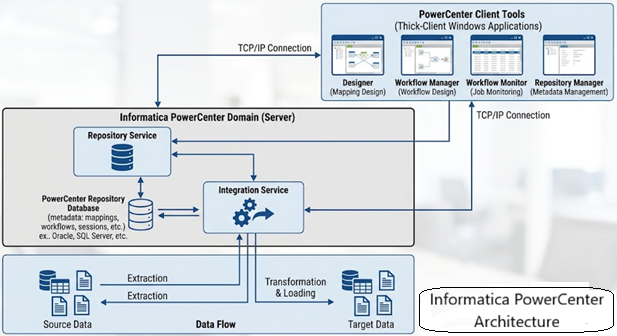
PowerCenter’s architecture is built around three core components:
Repository Service — stores metadata (mappings, workflows, sessions) in a relational repository database (Oracle, SQL Server, etc.)
Integration Service — the runtime engine that actually executes workflows, reading instructions from the repository
PowerCenter Client Tools — Designer, Workflow Manager, Workflow Monitor, Repository Manager — thick-client Windows applications that connect directly to the repository
Everything is tightly coupled to a specific installation. Metadata lives in a versioned repository that you manage, back up, and patch yourself. Scaling means adding more Integration Service processes on more physical or virtual nodes, and you’re responsible for high availability configuration, grid setup, and load balancing.
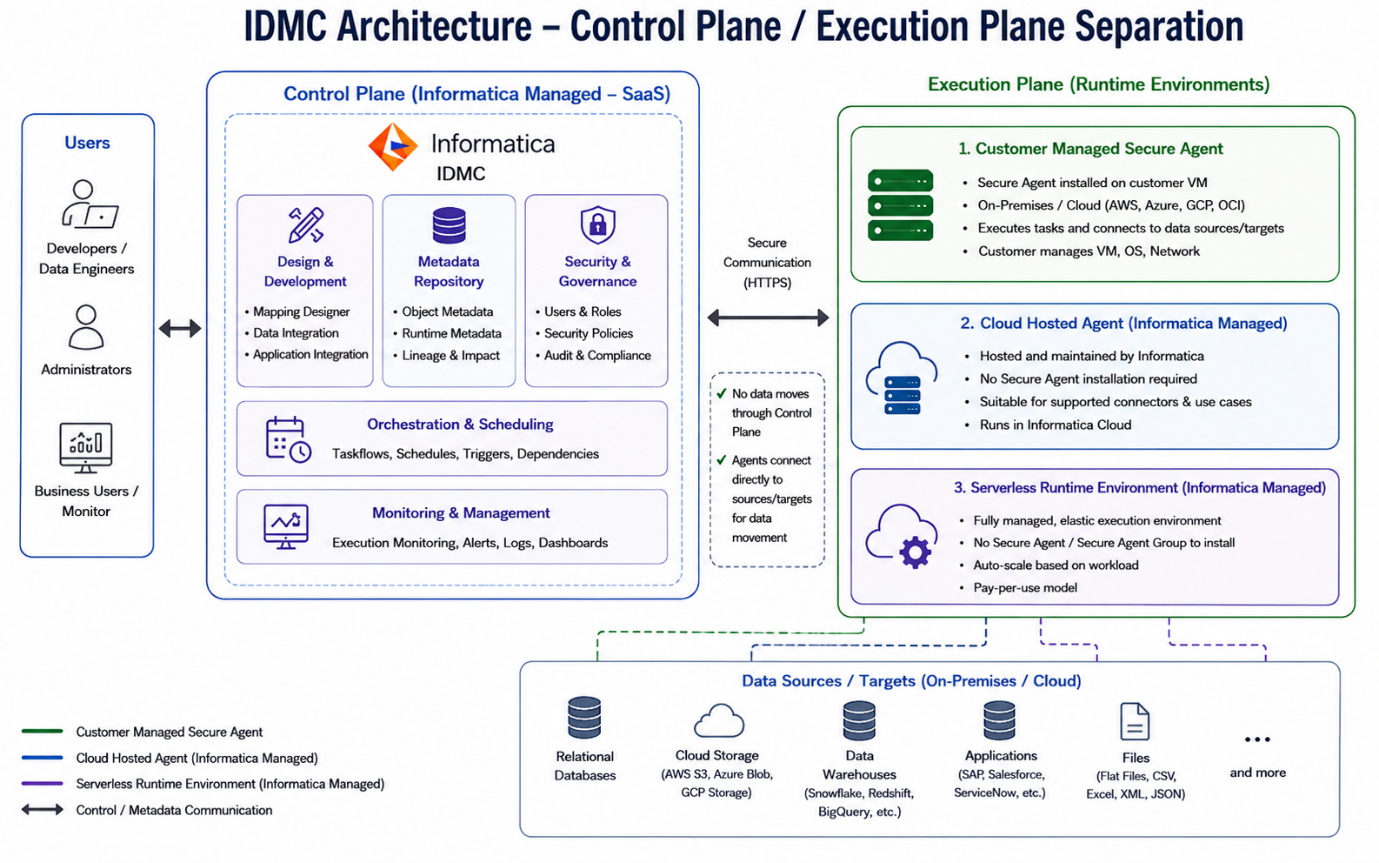
IDMC: Control Plane / Execution Plane Separation
IDMC uses a cloud-based control plane and distributed runtime/execution environments.
Control Plane — Informatica-managed SaaS
Hosts the IDMC services, browser-based design experience, metadata, security, administration, monitoring and orchestration.
Customers don’t manage the underlying IDMC cloud infrastructure.
Execution Plane — Where workloads run
Data processing runs in a selected runtime environment.
This can be a customer-managed Secure Agent, Cloud Hosted Agent, or Serverless Runtime Environment, depending on the service and workload.
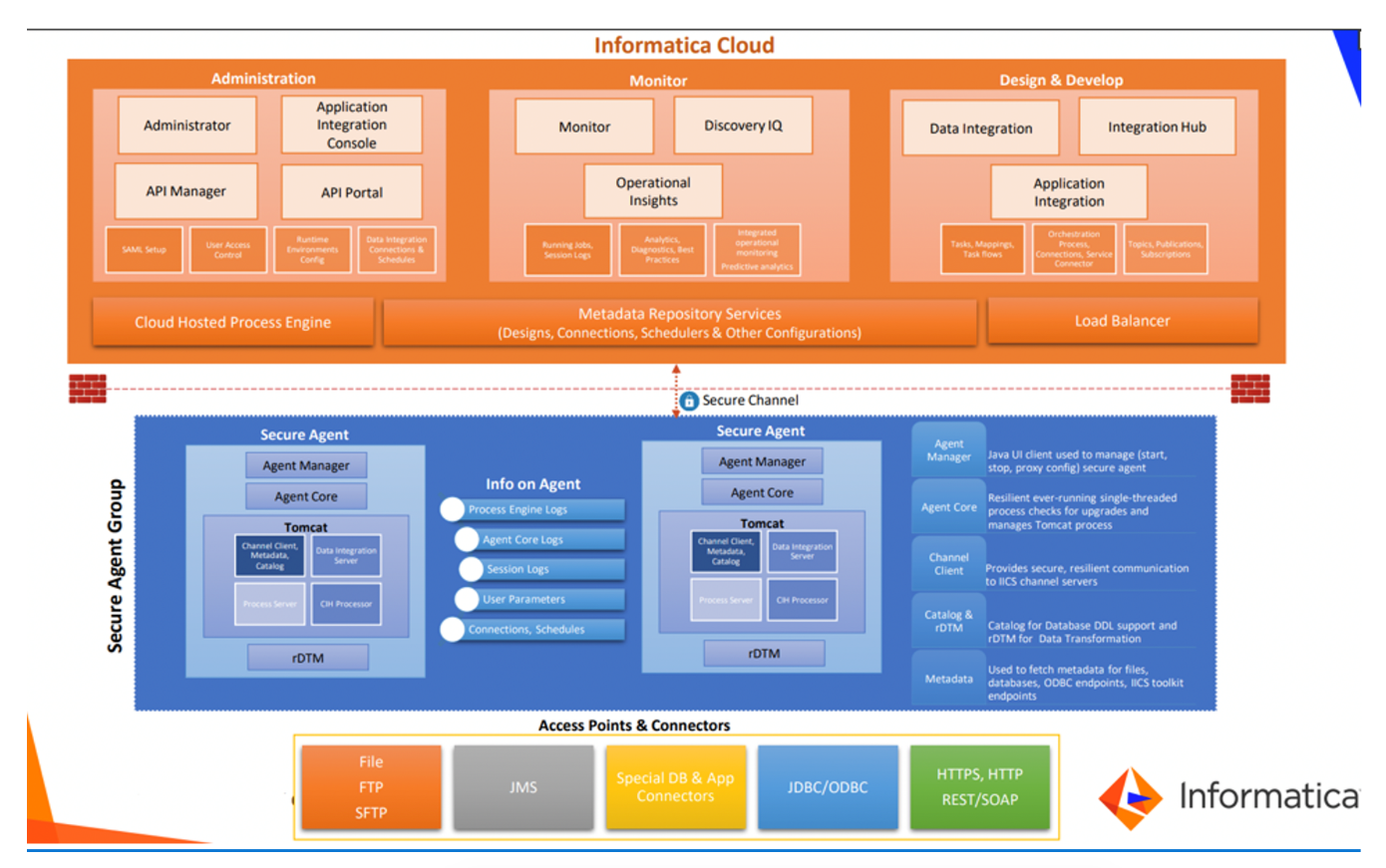
A Secure Agent is a lightweight runtime component that can run on-premises or in cloud environments such as AWS, Azure, GCP or OCI.
This separation decouples design and administration from execution. It means:
Browser-Based Access: Build and monitor workflows in a web browser without installing desktop software.
Flexible Scaling: Scale data-processing compute resources up or down without touching the metadata management layer.
Hybrid & Multi-Cloud Readiness: Manage agents across multiple cloud providers and local data centers from a single console.
Zero-Downtime Upgrades: Software enhancements deploy automatically, eliminating legacy multi-month upgrade projects. Upgrades to the platform itself are continuous and invisible to you — no more “PowerCenter 10.2 to 10.5” multi-month upgrade projects
2. Execution Model
| Aspect | PowerCenter | IDMC |
|---|---|---|
| Execution unit | Session (within a Workflow) | Task (Mapping Task, Synchronisation Task, etc.) within a Taskflow |
| Engine | Integration Service (single engine model) | Multiple pluggable engines — Spark, Databricks, native ELT push-down |
| Compute elasticity | Fixed grid nodes | Elastic — Serverless runtime spins compute up/down per job |
| Push-down optimization | Manual PDO configuration, database-specific | Native ELT-style push-down to Snowflake, Databricks, BigQuery, Redshift, etc. as default design pattern |
IDMC’s Cloud Data Integration (CDI) engine defaults to a more ELT-friendly mindset — pushing transformation logic down to cloud warehouses rather than always pulling data through a mapping engine, which is more relevant now that compute is cheap and elastic on platforms like Snowflake.
3. Development Experience
PowerCenter
Thick client (Windows-only Designer/Workflow Manager)
Mappings built with source/target/transformation objects wired manually
Version control via repository check-in/check-out, optional integration with external VCS (clunky)
Parameter files (.par) for runtime parameterization
IDMC
Browser-based, no client install (Mapping Designer, Taskflow Designer)
Same conceptual building blocks (transformations, sources, targets) but with a modernized UI and smart mapping recommendations
Native Git integration for version control (a huge quality-of-life upgrade)
In-app parameterization, plus support for parameter files similar to PowerCenter for migration continuity
4. Connectivity
PowerCenter connectivity relies on PowerExchange adapters and ODBC/native database connections configured per Integration Service node — connection objects are relatively static and tied to the repository. Adding or updating connections to modern endpoints—especially SaaS applications—requires manual patching, server configuration, and downtime whenever vendor APIs evolve.
In contrast, IDMC gives
- Zero-Touch Maintenance: When external SaaS platforms or cloud API endpoints update, Informatica handles the connector upgrades in the cloud. Teams no longer need to schedule server maintenance windows or manually apply PowerExchange patches.
- Rapid Endpoint Onboarding: Connecting to cloud platforms (like Snowflake, Databricks, BigQuery) or enterprise applications (like Workday or ServiceNow) requires only web configuration rather than server-side client driver installations.
- Hybrid Reach: Connectors work uniformly across both cloud sources and on-premises systems via the Secure Agent network, allowing seamless data flow across hybrid enterprise environments.
5. CDC and Real-Time Capabilities
PowerCenter: Real-time/CDC handled via PowerExchange CDC (log-based, Oracle/DB2/SQL Server), configured as a separate, fairly heavyweight product layered on top
IDMC: CDC is a native capability inside Cloud Mass Ingestion (CMI), with a much simpler setup experience, supporting database CDC, file ingestion, streaming ingestion (Kafka, Kinesis), and application ingestion — all under one umbrella product rather than a bolt-on
6. Governance, Metadata, and Catalog: A Unified Fabric
PowerCenter: Metadata is strictly limited to individual mappings and workflows within its local database repository. To get end-to-end enterprise lineage or data cataloging, you had to deploy separate, loosely integrated add-on tools like Metadata Manager.
IDMC: Built from the ground up on a single, unified metadata foundation. Every service—Cloud Data Integration (CDI), Data Quality (CDQ), Application Integration (CAI), MDM, and Cloud Data Governance & Catalog (CDGC)—shares the exact same engine.
Why This Matters:
Automated Lineage: Data lineage, business glossaries, and quality scores are generated automatically as you build your pipelines—no extra setup required.
Built-in Compliance: Data governance isn’t a secondary add-on; it is natively embedded into everyday data pipeline development.
7. Pricing Model
PowerCenter uses a traditional CapEx model, where costs are fixed and tied directly to CPU cores provisioned on your servers. While predictable, this static setup makes scaling expensive and rigid.
IDMC shifts to an OpEx model powered by Informatica Processing Units (IPUs). You purchase a pool of IPU credits and consume them based on actual pipeline runs, compute engines, and data volume. This consumption model provides flexibility, but it requires active FinOps monitoring—such as tracking IPU burn rates and setting usage alerts—to keep operational budgets under control.
9. Summary Table
| Dimension | Informatica PowerCenter | Informatica IDMC |
|---|---|---|
| Deployment | On-premises client-server architecture | SaaS Control Plane + distributed Data Plane (Secure Agents) |
| Scaling | Manual node addition and static grid management | Elastic auto-scaling with serverless options |
| User Interface | PowerCenter relies on desktop-installed client tools connected to a server | Web-based UI accessible directly via browser with CLAIRE AI design assistance |
| Installation & Maintenance | Self-managed installation, patching, and repository database | Cloud-hosted control plane maintained by Informatica |
| Connectivity | Native drivers and ODBC for on-premises systems. PowerExchange adapters tied to manual patch cycles | 300+ pre-built connectors with automatic SaaS updates (Snowflake, BigQuery, AWS S3, Salesforce) |
| Change Data Capture | Dedicated PowerExchange CDC installation | Native Cloud Mass Ingestion (CMI) service |
| Governance | Separate, add-on tools (Metadata Manager) | Native, unified metadata fabric across all cloud services |
| Version Control | Basic repository check-in/check-out | Native Git integration (GitHub, GitLab, Bitbucket) |
| Pricing Model | Capital Expenditure (CapEx) based on CPU cores (On-premises hardware and perpetual licensing) | Operational Expenditure (OpEx) based on IPU consumption |
| AI Capabilities | None native | CLAIRE AI engine integrated for mappings, quality, and lineage |
| Integration Capabilities | Enterprise ETL for high-volume data warehouses | Unified platform covering ETL/ELT, APIs, App Integration, and Governance |
PowerCenter provides a traditional, fixed on-premises foundation for legacy ETL workflows, whereas IDMC delivers an elastic, web-based platform with continuous SaaS updates, integrated AI, and built-in enterprise data governance.
The difference isn’t just where it runs — it’s a fundamentally different architecture for a fundamentally different era of data work.